
PRODUCTS CENTER

Brazil Energy storage equipment
Product Description
Energy Storage System
I. Basic Concepts
Energy storage systems store electricity when supply is abundant and prices are low, and release it during peak demand or high-price periods, helping to reduce carbon emissions, optimize power resource allocation, and ensure a stable electricity supply.
II. Working Principle
By working in tandem—through systems such as the Power Conversion System (PCS), Battery Management System (BMS), and Energy Management System (EMS)—the storage and release of electrical energy are achieved.
III. Main Functions
Reduce carbon emissions, enhance energy efficiency, and ensure the stability of electricity supply.
IV. Market Prospects
With technological advancements and declining costs, it will play a critical role in the global energy transition, with vast potential for application.
V. Application Scenarios for Industrial and Commercial Energy Storage
1. Traditional Industrial and Commercial Users
High-energy-consuming enterprises, shopping malls, office buildings, hotels, and other commercial venues.
2. Industrial Parks vs. Industry Clusters
Large-scale industrial parks, industrial zones
3. Data Center
Data centers that have extremely high demands for the reliability and stability of their power supply.
4. Integrated Photovoltaic Energy Storage Charging Station
Electric vehicle charging stations, highway service areas, and more.
5. Microgrid
Island regions, remote areas, and distributed energy projects.
6. Zero-Carbon Smart Park
A park dedicated to achieving carbon peak and carbon neutrality goals.
7. Distribution Network Substation Area
The end of the distribution network, such as small commercial areas, residential districts, and so on.
8. Communication Base Stations
Communication base stations require a stable power supply to ensure communication services.
9. Schools and Hospitals
Places with high demands for stable and reliable power supply, such as schools and hospitals.
6. Product Specifications
| 215 kWh Energy Storage Cabinet Product Specifications |
|
| Rated Capacity |
215kWh |
| Rated Charge and Discharge Power |
105kW |
| Nominal Voltage |
768V |
| Rated Output Voltage |
400V |
| Communication Output Wiring Method |
Three-phase five-wire Dy 11 |
| Isolation methods |
Power Frequency Isolation |
| Switching Time |
≤20ms |
| Operating Temperature Range |
-10°C to +50°C |
| Working Humidity Range |
≤ 9 0 % , None Dew |
| Main Functions |
Grid peak shaving, grid frequency regulation, and wind-solar-plus-storage integration |
| Thermal Management Methods |
Air conditioner + fan + heater |
| Fire protection methods |
Perfluorohexanone |
| External Communication Methods |
IEC 61850+ IEC 104, Ethernet Ethernet, RS485 |
| Protection Level |
IP54 |
7. Performance Features of the Product Cell (Lithium Iron Phosphate Cell)
1. High energy density
2. Long lifespan
3. Fast Charging
4. High Security
Lithium iron phosphate batteries generate less heat during charging and discharging, making them less likely to trigger safety issues such as thermal runaway.
5. Excellent stability
Lithium iron phosphate batteries exhibit stable electrochemical performance and can maintain consistent functionality across various environmental conditions.
6. High Reliability
Lithium iron phosphate batteries undergo rigorous quality control and testing, ensuring high reliability and meeting the demands of various application scenarios.
| Cell performance | ||
| Nominal Capacity | 280Ah, (0.5C, 25±2℃) | |
| Nominal Voltage | 3.2V | |
| Positive electrode material | Lithium iron phosphate | |
| Charging Cut-off Voltage | 3.65V | |
| Discharge cut-off voltage | 0℃ ≤ Temperature T ≤ 55℃ | 2.5V |
| -20℃ ≤ Temperature T < 0℃ | 2.0V | |
| Standard Charging Method | Under ambient temperature conditions of (25±2)℃, charge using a constant-current-to-constant-voltage method. The constant-current charging rate is 0.5C, and the constant-voltage level is 3.65V. During the constant-voltage phase, charging will stop once the current drops to 0.05C, followed by a 1-hour rest period. | |
| Standard Charging Current | 0.5C (25±2℃) | |
| Maximum Sustainable Charging Current | 1C | |
| Maximum Pulse Charging Current | 1.5°C ≤ 30°C | |
| Standard Discharge Current | 0.5C (25±2℃) | |
| Maximum Sustainable Discharge Current | 1C | |
| Maximum Pulse Discharge Current | 2C ≤ 30S | |
| Work environment | Charging: 0°C to 55°C, Max. 90% RH (Charging conditions follow charging mechanism 3.2) | |
| Discharge: -20°C to 55°C, Max. 90% RH (Discharge conditions according to discharge mechanism 3.2) | ||
| DC Internal Resistance | ≤1.0 mΩ (10 s, 50% SOC) | |
| Cell weight | 5.42 ± 0.3 kg | |
8. Operational Characteristics of Energy Storage Devices
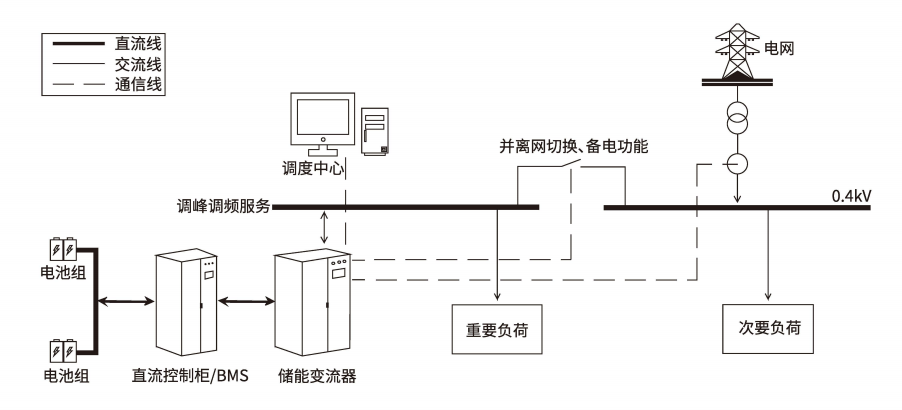
The energy storage cabinet is hung beneath the AC busbar of the homeowner’s transformer. It charges during off-peak/normal hours and discharges during peak hours to supply power to the other electrical devices connected to the busbar—effectively acting as an additional transformer. This setup has no impact on the existing distribution system, and because the quality of the stored energy delivered during discharge exceeds that of the grid itself, it also enhances the overall quality of electricity supplied to the users.
1. Standalone operation
Energy storage devices connected in parallel to the power grid have no impact on existing power supply equipment, and even if the energy storage device fails, it will not affect users' electricity consumption.
2. Remote Control
Energy storage systems quantify electricity cost savings using grid-connected meter data, and by monitoring load fluctuations at key metering points, they dynamically adjust charging and discharging power to match users' varying energy consumption patterns.
3. Flexible Management
Energy storage systems can work in tandem with photovoltaic systems and charging station systems to provide users with flexible power distribution management.
4. Backup Power Supply
Energy storage systems can provide independent power supply during grid outages, ensuring normal operation of loads and minimizing economic losses caused by power failures.
9. Remote Monitoring of Energy Storage Equipment
The energy storage monitoring cloud platform features comprehensive functions for monitoring and managing energy storage stations, including site overviews, real-time equipment operation tracking, fault alerts, video surveillance, fire safety monitoring, and detailed report-based performance analysis. These capabilities enhance the centralized monitoring and operational maintenance of energy storage stations, enabling remote supervision and unmanned operations, optimizing operational strategies, and ultimately boosting economic efficiency.
10. Product Advantages
1. Modular Design
Supports flexible configuration, enabling the energy storage system to scale from 100 kWh up to tens of megawatts, while facilitating easy installation, maintenance, and expansion.
2. High Integration
Integrating BMS, PCS, thermal management, and fire protection data monitoring systems creates an all-in-one energy storage solution, reducing on-site work while enhancing system reliability and safety.
3. Efficient Energy Conversion
By adopting a highly efficient multilevel topology and modulation technology, the system achieves a conversion efficiency exceeding 91%, enhancing energy efficiency while reducing operational costs.
4. Intelligent Monitoring and Control
Built-in with multiple operating modes, the system allows operational data to be integrated into a cloud platform, enabling remote monitoring and unattended operation, optimizing running strategies, and enhancing economic efficiency.
5. Safe and Reliable
Adopting Tier 3 or Tier 4 BMS and Level 9 safety monitoring & early warning systems, coupled with PACK-level fire protection technology, ensures the safe operation of the battery system while minimizing risks.
6. Outdoor Adaptability
Protection rating IP54 or IP55, designed to withstand harsh outdoor environments, minimizes site requirements and is suitable for a wide range of outdoor commercial and industrial applications.
7. Fast On-Grid and Off-Grid Switching
Supports seamless and off-grid rapid switching, with a switchover time of less than 15ms, ensuring continuous power supply during grid failures.
8. Flexible Charge-and-Discharge Mode
Supports multiple charging modes such as constant current, constant power, equalization charging, and float charging, allowing flexible adjustment of charging strategies to meet diverse needs and extend battery life.
11. After-Sales Service
1. Remote Monitoring and Technical Support
24/7 remote monitoring and analysis, real-time feedback on system status, and rapid technical support to minimize users' operational and maintenance costs.
2. Spare Parts Supply Service
Sufficient spare parts inventory ensures quick replacements during failures, minimizing downtime and safeguarding the continuity of users' business operations.
3. Installation and Debugging Services
A professional team is responsible for ensuring the energy storage system operates smoothly after on-site installation, thereby reducing user risks.
4. Regular Inspection and Maintenance Services
Regular inspection and maintenance, including battery checks and performance tests, ensure long-term system stability and extend equipment lifespan.
5. Training Services and Warranty After-Sales Support
We provide operational and technical training to help users become proficient, along with free repairs during the warranty period, ensuring long-term benefits for our customers.
12. Case Studies
Wenzhou Industrial Park Energy Storage Project
Zhuhai Industrial Park Energy Storage Project
Dongguan Industrial Park Energy Storage Project
Jiangmen Industrial Park Energy Storage Project
Shandong Tai District Photovoltaic-Storage-Charging Project
Shenzhen Industrial Park PV and Energy Storage Project
Huaqiao City Industrial Park Energy Storage Project
Shenzhen AEE Station Energy Storage and Charging Project
Shenzhen Low-Carbon Community Energy Storage Project
Daliangshan Retired Battery Microgrid Solar-Storage Project
: next page

Company Address:
No. 9 Qianfeng North Road, Shiji Town, Panyu District, Guangzhou City

Follow us
Copyright © Guangzhou Yibian Electrical Equipment Co., Ltd. Urban sub station Power by 300.cn SEO